The European Council on Foreign Relations

What does China think?

By Mark Leonard - 11 Feb 08


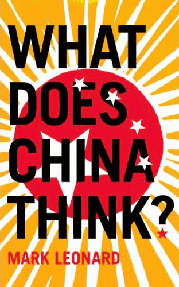
Mark Leonard China bookWe know all about the statistics of China's rise - dizzying growth rates, vast currency reserves, new cities built every week - but we have heard very little about China as a powerhouse of ideas about politics, economics and world order.

In my latest book, published by Fourth Estate in February 2008, I look at the Chinese model of globalisation which I argue could re-shape the face of Africa, Latin America and the Middle East. I am trying to show how experiments with focus groups and opinion polls are changing China from a traditional authoritarian state to a new 'deliberative dictatorship', and reveal how Beijing hopes to use a "China Dream" to challenge the US' military power. 

The book charts the development of a new Chinese world view and identifies the following different factions battling for influence:

  • The "New Left" who want a gentler form of capitalism with a social safety net that could reduce inequality and protect the environment;
  • The "New Right" who think that freedom will only come when the public sector is dismantled and sold off, and a new, politically active "propertied class" emerges;
  • The "Neo-Comms", cousins of American neo-cons, want to use military modernisation, cultural diplomacy and international law to assert China's power in the world.

I argue that in the future, the West willl be just as interested in the Chinese "Neo-Comms" plans for Asia as it is now in the "Neo-Cons" attempts to reshape the Middle East. Soon, the political struggle in the Communist Party will be seen as vital as the battle between the US presidential contenders; and protesters outside the World Bank will complain as much about the "Beijing Consensus" as they do about the "Washington Consensus".

VIDEO


An interview with Mark Leonard on Foreign Exchange with Daljit Dhaliwal, recorded in Washington, D.C on 16 May 2008.


AUDIO

You might need to install the appropriate software to be able to listen to these MP3 files. For more information, please click here.

Listen to a discussion on BBC Radio 4's Start the Week, recorded on 11 February 2008.

Listen to Mark Leonard on BBC Five Live with Simon Mayo on China's emergence as a world power, recorded on 18 February 2008.
Listen to part 1    
Listen to part 2    
Listen to part 3    
Listen to part 4

Listen to Mark Leonard on WNYC - The Brian Lehrer Show, recorded in New York on 6 May 2008.

Listen to an interview on ABC Australia, broadcasted on 2 May 2008.

Tags: Asia

3 Comments

#1

“Neo-Comms” and “Beijing Consensus”. Sounds like really interesting reading. Change is underway in China and its time to get an in-depth analysis. Cant wait for the book to be published and I hope every ECFR reader and supporter will read it!

Lukas Vitalijus | Canada-EU | 15 Feb 08, 15 Feb 08 EST
#2

Intellectuals and scholars have to conform themselves to the National party too much. This is why we don’t know what they think. Furthermore they don’t want to reveal there way of thinking too much to the outside world.

Sham Bhaggoe | The Hague | 17 Feb 08, 17 Feb 08 EST
#3

Ideas into reality for all to see,can make even the most sceptical become believers. Vision, perseverance with patience and benefit for all. The chinese model? Will the west oversleep and wake up too late!

Ian G Whittaker | England | 11 Mar 08, 11 Mar 08 EST

Submit a Comment

Your message will be submitted to a moderator before appearing online. Name and email address are required, all other fields are optional. Your email will not be displayed.

Please enter the word you see in the image below:

Remember my personal information

Latest Publications

China shapes its post-crisis economic agenda

The latest issue of China Analysis looks at Beijing’s willingness to strengthen international economic governance, and argues that much thinking in China seems to focus on the short term

China and India: rivals always, partners sometimes

The latest issue of China Analysis argues that Western concerns over “Chindia” - the emergence of a Sino-Indian economic power bloc or strategic alliance - may be unwarranted. 

Towards a post-American Europe: A Power Audit of EU-US Relations

Europe has the US president it wished for, but Barack Obama lacks the strong transatlantic partner he wants.

Can the EU rebuild failing states? A review of Europe’s civilian capacities.

Broken promises and treating Afghanistan, DR Congo and Iraq like Bosnia has left the EU without the capacity to prevent fragile states from becoming failing states.

Supporting Moldova's democratic transition

If EU leaders are looking for ways to make the Eastern Partnership successful, there are worse places to start than Moldova.

What does Russia think?

ECFR publishes collection of views from key Russian intellectuals.

The EU and human rights at the UN: 2009 annual review

The EU’s ongoing loss of influence at the UN is putting lives at risk, argues ECFR’s latest paper.

China’s response to the G2

Fears in Europe that China works to lock the US into a “G2” embrace so as to dominate the global agenda do not reflect Chinese experts’ current strategic thinking.

European and Russian power in the troubled neighbourhood

A complacent strategy focusing on slow change rather than pressing crises is losing the EU its battle with Russia for influence in the eastern neighbourhood.

Beyond the “War on Terror”

The EU should seize the opportunity to influence President Obama’s efforts to reform US counterterrorism policy.

A Power Audit of EU-China Relations

China is exploiting the EU’s divisions and treating the 27-state bloc with “diplomatic contempt” on issues ranging from trade to the Dalai Lama.

Shaping Europe's Afghan Surge

The military surge in Afghanistan will fail unless it comes with a civilian surge as part of a new strategy.

Re-wiring the US-EU relationship

With the pivotal change of leadership in Washington, the US and the EU are presented with an ideal moment to strengthen the US-EU institutional bond.

Beyond dependence: How to deal with Russian gas

Building a single European market in natural gas is the most effective strategy for the European Union to counter Russia’s divisive energy diplomacy.

Promoting democracy abroad - the EU's record

In a joint research project with FRIDE, ECFR looks at the EU’s record in Azerbaijan, Belarus, Ukraine, Jordan, Lebanon and Morocco.

The EU a global force for human rights?

The EU’s leverage to promote human rights through the UN has dramatically declined over the last decade, our exclusive report reveals.

Can the EU win the peace in Georgia?

This paper analyses the background and developments in the Russia-Georgia conflict and outlines recommendations on how to prevent wider political fallout.

Re-energising Europe's Security and Defence Policy

European governments cannot afford to move at the speed of the slowest and should push for a ‘multi-speed’ Europe on ESDP.

In the Press

International Herald Tribune - 09 Feb 10

Thomas Klau on how the economic crisis has affected Europe’s policy agenda.

The Times - 08 Feb 10

Andrew Wilson: Tymoshenko may contest Ukraine’s election results.

The Financial Times - 08 Feb 10

Andrew Wilson on Ukraine’s exit polls.

Reuters - 08 Feb 10

Ukraine: The question now is whether Tymoshenko will challenge.

The Observer - 07 Feb 10

Wilson: Tymoshenko has as many friends as the troubled English footballer John Terry.

Read more press >

Click here for ECFR's Youtube channel.