In need of an EU approach to China
Gordon Brown, like many of his EU counterparts, focussed on national interests and commercial contracts in his China trip last week. But EU leaders need to work together not compete with each other to benefit from China’s rise.

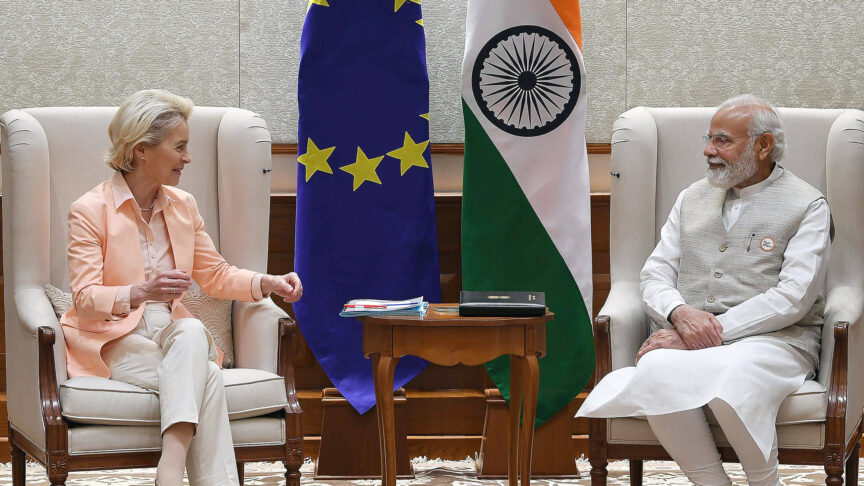
Gordon Brown’s visit to China last week appeared to be a resounding success for UK plc. With commitments to rapidly increase bilateral trade and investment, and the usual slew of contracts for British companies, the Prime Minister underlined how much the UK’s economic future depends on China. But how much are the UK and other EU member states making the most of the opportunities China presents when the highest level of engagement, especially by the big EU economies, is narrowly focussed on national interests.
British, French and German leaders in particular seem to expend a huge amount of energy trying to out do each other on China, rather than working together to extract maximum benefit for Europe (and consequently their own national economies) from China’s rise. And in confrontations with China, EU leaders more often than not undermine each other’s positions rather than support them (e.g. on Arms Embargo, Market Economy Status, human rights, and Taiwan).
European leaders do however find common ground when it comes to global, rather than bilateral, issues. Britain, France and Germany have consistently presented a united front to China on Iran nuclear and as a result have secured significant movement from a Chinese Government that would otherwise have probably not supported UN Security Council action. The same is true on Sudan-Darfur. So why isn’t this the case when dealing with China’s impact on the EU’s fundamental economic and political interests?
One of the main achievements of President Sarkozy’s visit to China in November 2007 was contracts for $17.4 billion worth of Airbus planes. This benefits the UK, Germany and Spain (where Airbus planes are made) as much as France, but there was no mention of this during Sarkozy or Prime Minister Brown’s visit.
Next time he sees China’s leaders, I would urge the Prime Minister (and other European leaders) to take European business leaders with him; to encourage an ambitious trade and investment target between Europe and China; to lobby for the opening up of Chinese markets that benefit European businesses; to support the EU-China economic dialogue (rather than create a parallel UK-China one); to work with President Sarkozy to re-energise the EU-China Partnership on Climate Change (rather than both the UK and France creating bilateral ones); to commit £50 million to EU energy efficiency, renewable energy, clean coal and carbon capture and storage technology transfer (for example via the proposed EU-China Clean Energy Centre); and to support Chancellor Merkel’s values-based approach to China and robust line on human rights.
Last year China hosted most of the 50 African heads of state for a China-Africa summit. Maybe it’s time for European leaders to forge a common approach to China and go there together to get some real business done.
The European Council on Foreign Relations does not take collective positions. ECFR publications only represent the views of their individual authors.